
Bail Rejected? Next Steps After a Magistrate, Sessions or High Court Order
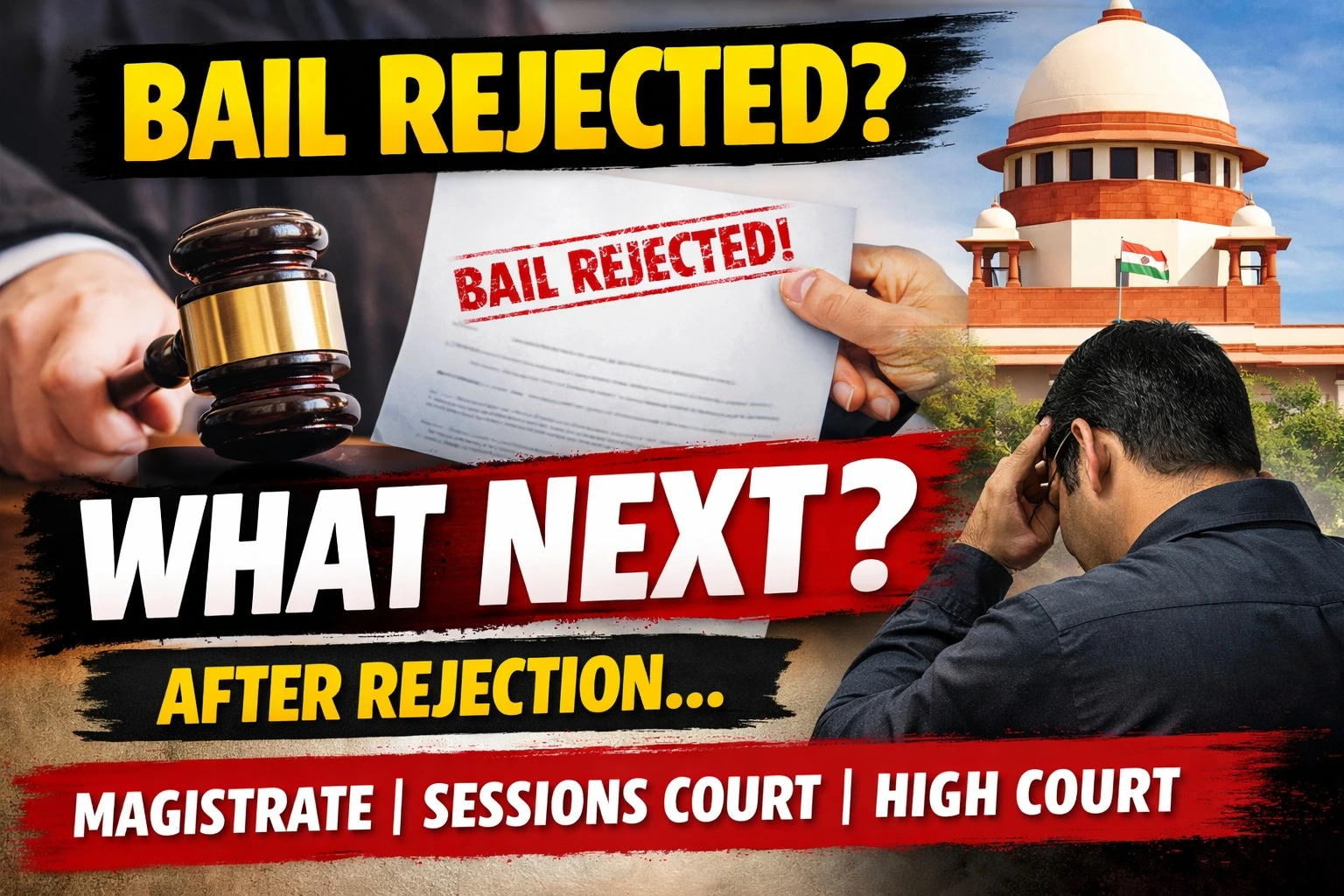
If bail has been rejected, the case is serious, but the position is not closed.
A rejected bail application does not mean that all remedies are over. The correct next step depends on three things: which court rejected the bail, what reasons were given in the rejection order, and whether there are fresh grounds that can materially change the position. Under the Bharatiya Nagarik Suraksha Sanhita, 2023, regular bail in non-bailable offences is dealt with in section 480, anticipatory bail in section 482, and the special powers of the High Court or Court of Session are set out in section 483.
At this stage, random filing is a mistake. The matter requires an ordered response.
Step 1: Read the rejection order before doing anything else
The first task is to examine the bail rejection order carefully.
A proper next move cannot be decided without identifying why the court refused relief. In practice, courts usually focus on one or more of the following: seriousness of the allegation, prima facie material, risk of absconding, possibility of witness influence, risk of tampering with evidence, or the stage of investigation.
The question is not merely whether bail was rejected. The question is why.
Step 2: Move to the correct higher court
The next remedy often depends on the court that has passed the rejection order.
If bail was rejected by a Magistrate, the next move is usually before the Sessions Court. If it was rejected by the Sessions Court, the matter is ordinarily taken to the High Court. If the High Court has rejected bail, the next strategy may involve either a fresh move on new grounds or approaching the Supreme Court, depending on the facts, urgency, and the contents of the order. Section 483 BNSS specifically gives the High Court and Court of Session special powers regarding bail.
A better court is not enough by itself. The case must also be put better.
Step 3: Do not file again on the same weak grounds
A second or successive bail application should not be a repetition of the earlier one.
As a matter of practice, repeated bail filings without a meaningful change in circumstances are usually weak. A later application becomes materially stronger where there is a real development such as prolonged custody, deterioration in health, filing of the charge sheet, delay in trial, change in role attributed to the accused, or some other fresh circumstance.
This is where most poorly drafted bail matters fail. They file again without changing the legal foundation.
Step 4: If anticipatory bail is rejected, the strategy changes immediately
If the rejected application was for anticipatory bail, the case has to be repositioned without delay.
Section 482 BNSS deals with anticipatory bail and empowers the High Court or Court of Session to grant pre-arrest protection subject to conditions, including cooperation with interrogation, non-interference with witnesses, and restrictions on leaving India without permission. Once anticipatory bail is rejected, the next move cannot be handled casually. The defence has to decide whether to seek higher-court protection, prepare for surrender and regular bail, or proceed on some other fact-specific route.
Wrong timing at this stage can convert a manageable matter into unnecessary custody.
Step 5: Check for statutory or default bail
Under section 187 BNSS, where investigation is not completed within the prescribed period, the accused becomes entitled to bail if prepared to and does furnish bail. The period is ninety days where the investigation relates to an offence punishable with death, life imprisonment, or imprisonment for ten years or more, and sixty days for other offences.
That issue should be checked immediately in any custody matter. It is not a side point. In the right case, it is the decisive point.
Step 6: Check whether prolonged detention itself creates a fresh bail ground
BNSS also contains an undertrial-detention safeguard.
Section 479 BNSS provides for release on bail where an undertrial has undergone detention up to one-half of the maximum period of imprisonment specified for the offence, with a one-third threshold for certain first-time offenders, subject to the statutory qualifications.
In a long-running case, this may become critical.
Step 7: Build the next bail attempt around evidence, not adjectives
The next application should be built on materials that reduce judicial concern.
Depending on the case, that may include:
- medical records
- proof of stable residence
- employment or business ties
- family dependency material
- absence of criminal antecedents
- cooperation with investigation
- charge-sheet developments
- contradictions in the prosecution case
- long custody without meaningful progress
The objective is to reduce perceived risk in the eyes of the court.
Common mistakes after bail rejection
The usual errors are predictable:
- filing a higher-court petition without dealing with the actual reasons for rejection
- repeating old grounds in different language
- ignoring fresh facts that have emerged after rejection
- mishandling the anticipatory-bail to regular-bail transition
- overlooking statutory/default-bail issues
- waiting passively while custody lengthens
- filing badly drafted petitions that do not frame the case sharply
Most rejected bail matters are not improved by urgency alone. They are improved by structure.
When bail is rejected, the next legal step must be chosen carefully and without delay. At Thukral Law Associates, matters involving bail rejection are assessed through the rejection order, the stage of investigation, the custody position, the available fresh grounds, and the correct forum for the next move. The focus is on building a stronger, better-structured application rather than repeating a weak one.
FAQ
1. What should be done immediately after bail is rejected?
The rejection order should be reviewed first. The next remedy depends on the court that rejected bail, the grounds recorded by that court, and whether fresh circumstances now exist.
2. Can bail be filed again after rejection?
A fresh application may be possible, but it is materially stronger where there is a genuine change in circumstances such as prolonged custody, health issues, charge-sheet filing, or delay in trial.
3. What if anticipatory bail is rejected?
The case must be reassessed immediately. Section 482 BNSS governs anticipatory bail, and the next move may involve higher-court proceedings, surrender strategy, or a regular bail plan depending on the facts.
4. What is default bail?
Under Section 187 BNSS, where investigation is not completed within the statutory period, the accused becomes entitled to default bail if prepared to and does furnish bail. The period is 90 days for more serious offences and 60 days for other offences.
5. What if the Sessions Court rejects bail?
The matter is ordinarily moved to the High Court with a better-framed case, especially if the earlier order reveals the specific concerns that must now be addressed directly.
6. What if the High Court rejects bail?
The next strategy may involve a fresh move on new grounds or approaching the Supreme Court, depending on the order and the facts of the case.
📞 Get Legal Help Today
Looking for a criminal lawyer in Delhi? Contact Karan Singh Thukral today!
Contact today to discuss your case and get clear legal guidance. Reach out to Karan Singh Thukral today!
📞 Call/WhatsApp: +91-99990-09339
📧 Email: infothukral@gmail.com
🌐 Website:
www.karanthukral.com
Contact Now
